


-
 Jan 10 , 2026
Women's Rights in Afghanistan Under Taliban Rule: A Review
Introduction
By Participants of “Advancing Women's Rights Project", FTN-N
Afghanistan has experienced major and often fragile political transformations throughout its history, particularly in recent years. One of the most tragic of these developments was the Taliban’s return to power on August 15, 2021. This political shift and regression have had far-reaching consequences for the lives of the Afghan people, especially women.
Prior to this, during the Republic era, Afghanistan had made relative progress in women’s rights. Women had achieved notable advancements in areas such as education, employment, and social participation. However, following the Taliban’s re-establishment of control, many of these gains have faced severe restrictions.
Since women constitute half of society and play a vital role in the country’s social and economic development, the current severe limitations on their fundamental rights make sustainable development and prosperity in Afghanistan impossible without their meaningful participation. The purpose of this article is to examine the status of women’s rights in Afghanistan under Taliban rule. It also analyzes the Taliban’s “Promotion of Virtue and Prevention of Vice” law as a key instrument of restrictions on women and compares the current situation with Afghanistan’s Constitution and international human rights standards.
The Status of Women’s Rights in Afghanistan Under Taliban Rule
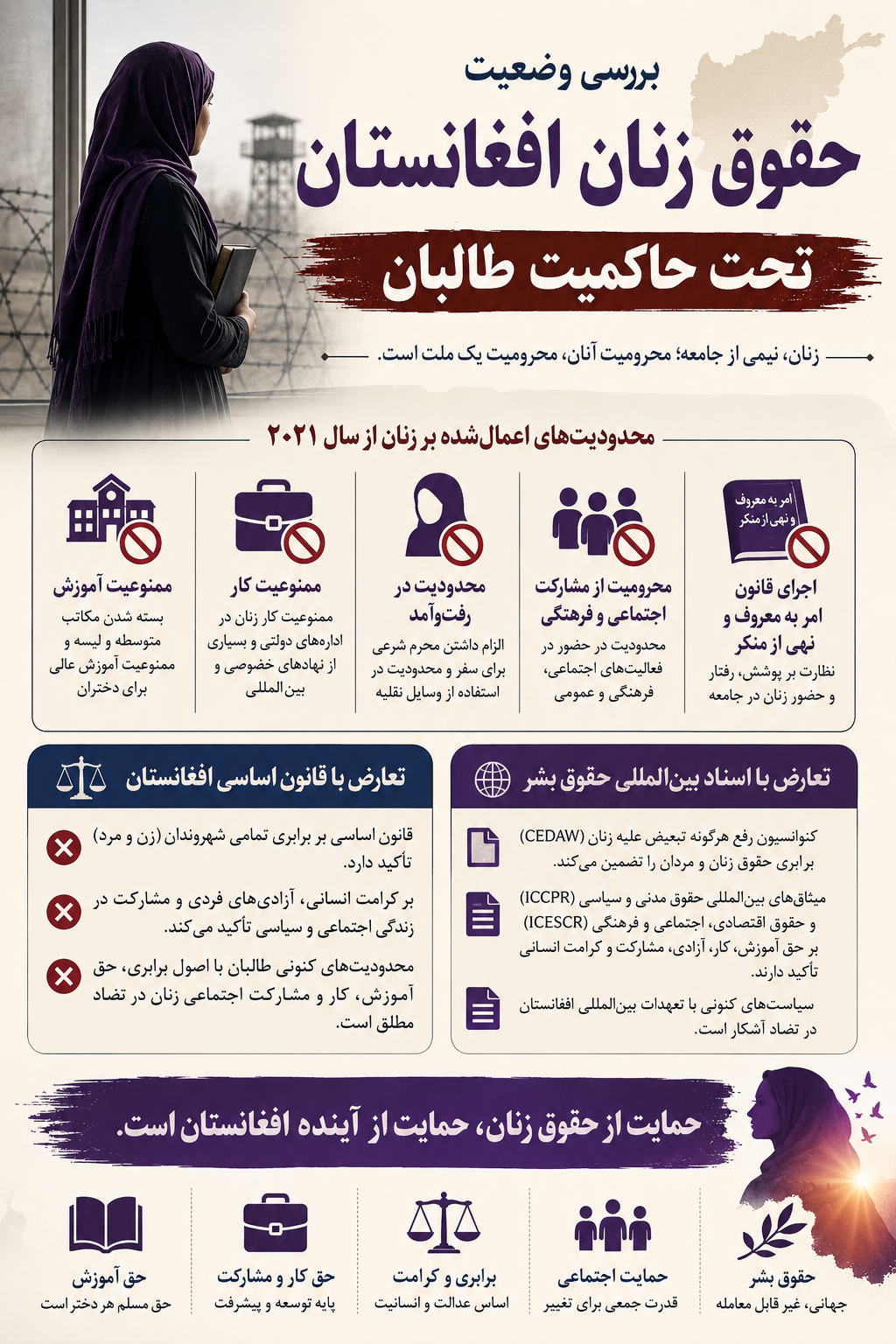
Following the Taliban’s takeover on August 15, 2021, extensive restrictions were imposed on women’s lives. One of the most significant measures has been the closure of secondary and high schools for girls in many provinces, along with the ban on women attending universities. As a result, millions of girls have been deprived of continuing their education.
Additionally, many women have been barred from working in government offices and even in some private and international organizations. This has created serious economic and social difficulties for families and has effectively isolated half of Afghanistan’s population. Further restrictions include limits on women’s freedom of movement, as well as exclusion from cultural and social activities. In many cases, women may only travel if accompanied by a male mahram (close male relative). Women traveling without one risk interrogation at checkpoints and punishment by the Ministry for the Promotion of Virtue and Prevention of Vice.
A primary tool for enforcing these restrictions is the Taliban’s “Promotion of Virtue and Prevention of Vice” law. Enforced by the Ministry for the Promotion of Virtue and Prevention of Vice, this law regulates women’s dress, social behavior, and public presence. It has normalized treatment of women that violates human dignity and constitutes human rights abuses, with little to no public pushback. Consequently, many of women’s individual rights and freedoms have been curtailed under the guise of preserving public morality and chastity.
Comparison with Afghanistan’s Constitution
Afghanistan’s Constitution, ratified in 2004 (1382 in the Afghan solar calendar), serves as the supreme law of the land and explicitly emphasizes the equality of women and men. Article 22 states that all citizens of Afghanistan are equal before the law, and no discrimination shall exist between citizens (whether men or women).
The Constitution also underscores human dignity, individual freedoms, and citizens’ participation in political and social life. Based on these principles, women have the right to active and meaningful participation in education, employment, politics, and other social and cultural activities.
However, the restrictions imposed by the Taliban—such as bans on girls’ education, limitations on women’s employment, and reduced social participation—directly contradict many provisions of the Constitution, as well as other national laws including the Labor Law, Election Law, Penal Code, Law on the Elimination of Violence Against Women, and laws against the harassment and trafficking of women and children.
Comparison with International Human Rights Instruments
As a member of the United Nations, Afghanistan has acceded to several key international human rights treaties and has committed to implementing their provisions within its legal framework, including Islamic principles.
One of the most important is the Convention on the Elimination of All Forms of Discrimination Against Women (CEDAW), which stresses equality between women and men. Under this convention, Afghanistan is obligated to guarantee gender equality in its laws, administrative structures, and executive bodies.
Afghanistan is also a party to the International Covenant on Civil and Political Rights (ICCPR) and the International Covenant on Economic, Social and Cultural Rights (ICESCR). These documents affirm the rights to education, work, freedom of expression, and social and cultural participation.
According to these instruments, Afghanistan must create conditions that enable women to enjoy equal rights with men and play a meaningful role in the country’s development. Yet the policies and restrictions implemented since the Taliban’s return to power starkly contradict these international commitments, resulting in daily violations of the human rights of Afghan citizens—particularly women.
Conclusion
This review of women’s rights in Afghanistan under Taliban rule reveals that many of women’s fundamental rights have been subjected to severe restrictions. Barriers to education, employment, freedom of movement, and social participation are among the main challenges Afghan women currently face.
While these rights are clearly recognized in Afghanistan’s Constitution and international human rights documents, current policies have significantly diminished women’s role in society. This situation carries profound social, economic, and psychological consequences for the entire country.
Therefore, greater attention to women’s rights, raising public awareness, and stronger international support for Afghan women’s human rights will be essential for improving their situation in the future.
References
- Islamic Republic of Afghanistan. (2004). Constitution of the Islamic Republic of Afghanistan.
- Islamic Emirate of Afghanistan. (2021). Law on the Promotion of Virtue and Prevention of Vice.
- United Nations. (1979). Convention on the Elimination of All Forms of Discrimination Against Women (CEDAW).
- United Nations. (1948). Universal Declaration of Human Rights.
- United Nations. (1966). International Covenant on Civil and Political Rights (ICCPR).
- United Nations. (1966). International Covenant on Economic, Social and Cultural Rights (ICESCR).