

-
 May 15 , 2026
Intersecting Discrimination: Minority Women in Afghanistan
Contributors: Participants of the “Advancing Women’s Rights Program”, FTD-N
Introduction
In many multicultural societies, including Afghanistan, discrimination against certain social groups remains a major obstacle to achieving social justice and human development. Experience in Afghanistan shows that discrimination is rarely one-dimensional. Individuals with multiple social identities often face several forms of discrimination simultaneously.
Women from ethnic and religious minorities in Afghanistan are a clear example of this reality. In addition to gender-based discrimination, these women also experience prejudice due to their ethnic or religious identity. As a result, the discrimination they face is more complex and severe. This situation can have serious social, economic, and psychological consequences for their personal and social lives. Understanding the challenges faced by minority women therefore requires examining the combined effects of gender, ethnicity, and religion.
Gender-Based Discrimination
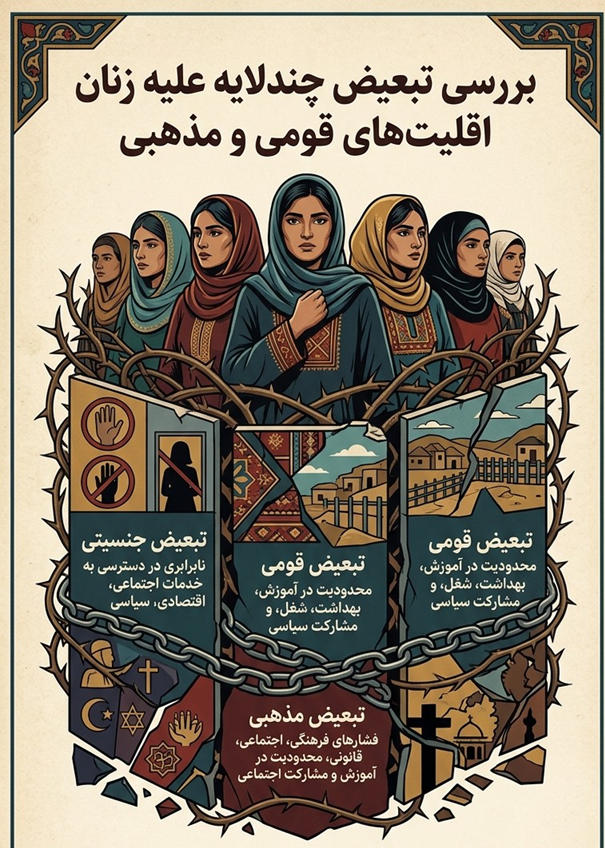
Gender discrimination is one of the most widespread forms of inequality in many societies, particularly in Afghanistan. Women often have less access than men to education, economic opportunities, healthcare, and political participation. In Afghanistan, economic, cultural, and political factors have placed women in a disadvantaged position compared to men.
Unfortunately, these challenges are multiplied for women from minority groups, who face additional layers of ethnic and religious discrimination.
Ethnic Discrimination
Ethnic minorities in many countries encounter barriers such as limited access to education, healthcare, employment, and political participation. Afghanistan is no exception. Minority women in certain regions face even harsher conditions. For example, Hazara women often experience compounded discrimination due to both their gender and ethnicity, resulting in severe restrictions on education and employment opportunities.
This not only limits their economic prospects but also affects their social security and safety.
Religious Discrimination
In societies where one religion is dominant, followers of minority faiths often face greater restrictions. Women from religious minorities are frequently subjected to cultural, social, and sometimes legal pressures that hinder their access to equal rights. These pressures may include limitations on education, employment, and social participation.
When gender, ethnic, and religious discrimination overlap, the challenges become significantly more complex. Policies and regulations that appear neutral on the surface can institutionalize systemic discrimination against minority women.
Consequences of Intersecting Discrimination
Intersecting discrimination can have multiple serious effects on minority women, including:
- Limited economic opportunities
- Deprivation of education
- Reduced access to healthcare services
- Lower social and political participation
- Increased psychological and social stress
These consequences not only violate women’s basic rights but also hinder the overall progress and development of society.
Conclusion
Intersecting discrimination against women from ethnic and religious minorities is a serious social and legal issue that arises from the combination of gender, ethnic, and religious biases.
This form of discrimination violates women’s fundamental rights and has far-reaching negative impacts on social and economic development. Meaningful change will only occur when there are genuine reforms in policies, laws, and administrative structures to address and reduce these multiple layers of discrimination.
References:
- United Nations. (1948). Universal Declaration of Human Rights.
- United Nations. (1979). Convention on the Elimination of All Forms of Discrimination Against Women (CEDAW).
- Human Rights Watch. (2024). Report on the Situation of Women and Minorities in Afghanistan. New York: Human Rights Watch.