

-
 Feb 10 , 2026
Educational Deprivation and the Future of Afghan Women
Contributors: Participants of the “Advancing Women’s Rights Program”, FTD-N
Introduction
Education is one of the most fundamental human rights. It empowers individuals with knowledge, improves quality of life, and drives societal progress.
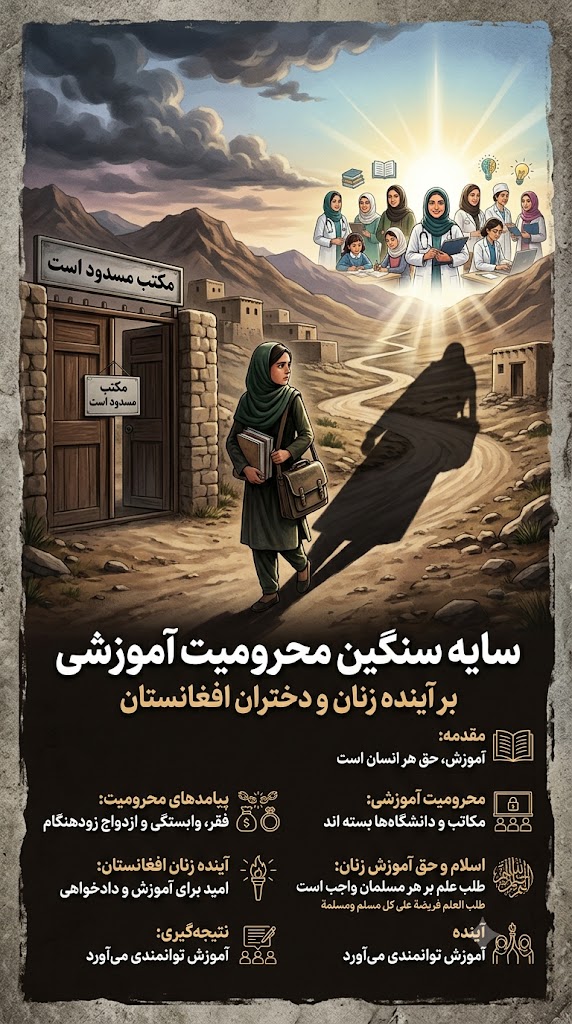
However, in Afghanistan today, millions of girls are being systematically deprived of this basic right. Since the Taliban’s return to power in August 2021, severe restrictions have been imposed on girls’ education. Secondary and high schools for girls have been closed, and women are banned from attending universities.
This crisis not only jeopardizes the future of Afghan girls but also undermines the long-term development of the entire country. This article examines the far-reaching consequences of educational deprivation for women and Afghan society as a whole.
Educational Deprivation in Afghanistan
In recent years, girls’ access to education has been dramatically curtailed. In many provinces, secondary and high schools for girls have been shut down, preventing large numbers of girls from continuing their studies. Additionally, women are prohibited from enrolling in universities in most parts of the country.
This has left hundreds of thousands of girls unable to pursue further education.
Education is essential for women, as it equips them with knowledge, skills, and confidence to play active roles in society. When girls are denied education, their future opportunities are severely limited.
Consequences of Educational Deprivation
The denial of education creates serious challenges at both individual and societal levels.
For women and girls, lack of education often results in fewer employment opportunities and greater economic dependence on male family members; particularly husbands. This dependence frequently leads to increased control over women’s lives and higher rates of domestic violence. A common Afghan proverb captures this reality: “Whoever provides the bread gives the orders.”
In many cases, educational deprivation has also contributed to a rise in early marriages, as families see few alternatives for their daughters in the absence of schooling or work opportunities.
At the societal level, excluding women who make up half the population from education, hinders national progress. It perpetuates poverty, slows economic growth, and weakens overall social development.
Islam and Women’s Right to Education
Islam places strong emphasis on the pursuit of knowledge for both men and women. The Prophet Muhammad (peace be upon him) stated:
“Seeking knowledge is obligatory upon every Muslim man and woman.”
Many Islamic scholars maintain that depriving women of education contradicts core Islamic principles, which consistently encourage the acquisition of knowledge and awareness for all believers.
Hope for the Future
Despite the significant barriers, many Afghan girls and women continue to pursue education through alternative means, including online learning, home-based classes, and informal educational programs.
Afghan women and human rights advocates are also actively raising awareness through national and international media and forums, calling for the restoration of women’s right to education. These efforts demonstrate that hope for a brighter future remains alive.
Conclusion
The systematic deprivation of girls from education represents one of the most pressing challenges facing Afghan women today. Education is a powerful tool for women’s empowerment and societal advancement. Without it, individuals cannot fully realize their potential, and societies cannot thrive.
Denying girls education harms not only their own lives but also the future of the entire nation. Providing quality educational opportunities for girls is therefore essential for Afghanistan’s sustainable development and prosperity.
References
- United Nations. (1948). Universal Declaration of Human Rights.
- United Nations. (1979). Convention on the Elimination of All Forms of Discrimination Against Women (CEDAW).
- UNESCO. (2023). The State of Education in Afghanistan: Challenges and Opportunities.