

-
 Mar 10 , 2026
Afghan Women: Denied Work and Healthcare
Contributors: Participants of the “Advancing Women’s Rights Program”, FTD-N
Introduction
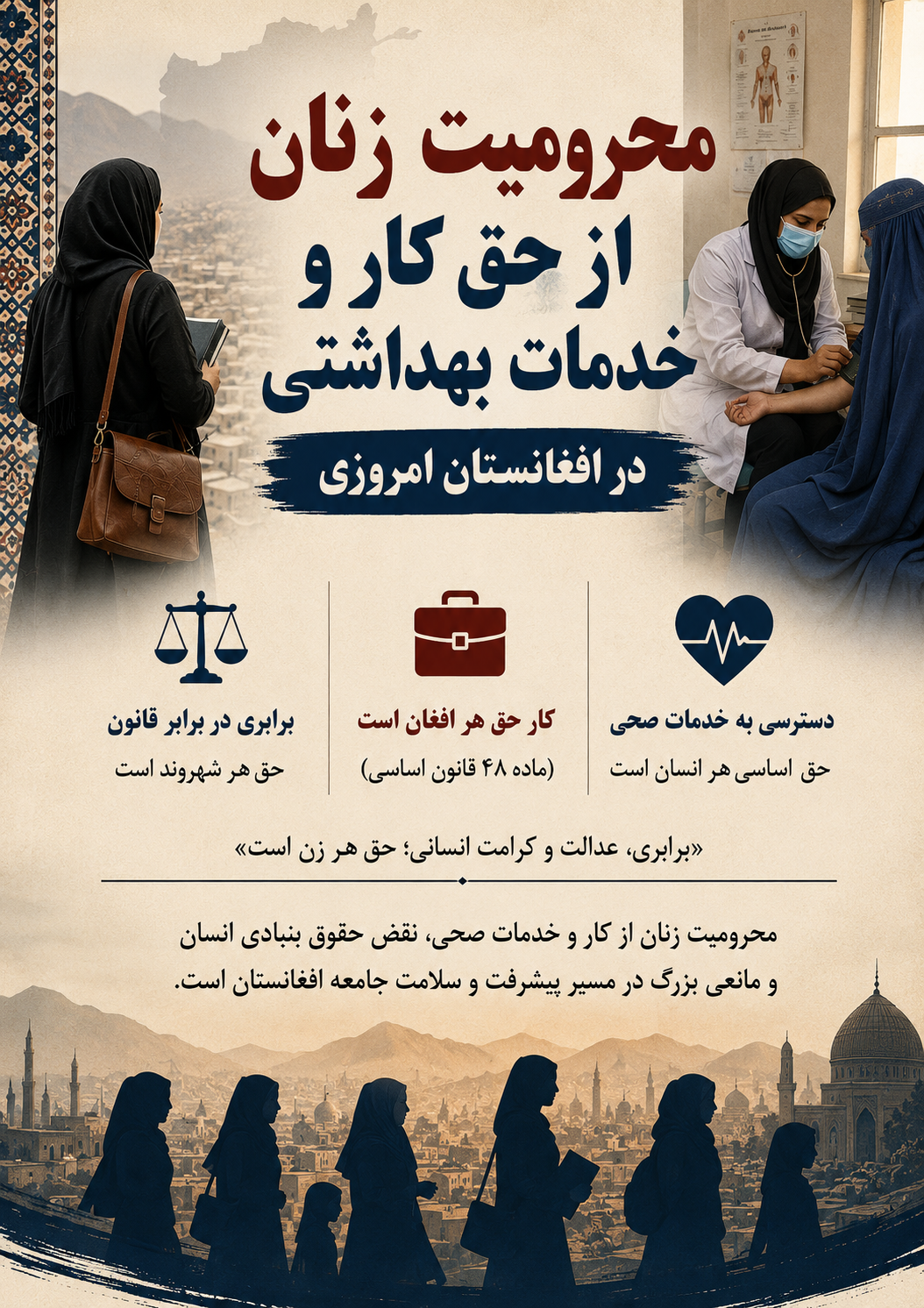
The right to work and access to healthcare are fundamental human rights, just like other basic rights. Every citizen of Afghanistan, women and men alike, is entitled to enjoy these rights without discrimination based on gender, ethnicity, or location. Afghanistan’s Constitution(2004) clearly emphasizes the equality of women and men before the law and their equal access to fundamental rights, including the right to work and healthcare.
However, under the current regime in Afghanistan, many women and girls face severe restrictions in both employment and access to healthcare services. Policies and rules enforced under the Taliban’s “Promotion of Virtue and Prevention of Vice” law have significantly limited women’s ability to exercise these basic rights. This article examines the deprivation of women from the right to work and healthcare in Afghanistan today.
National and International Legal Framework
Afghanistan’s Constitution (2004) clearly outlines the fundamental rights of citizens. Article 22 emphasizes equality between women and men, while Article 48 states that “work is the right of every Afghan.” The Constitution also obligates the state to provide healthcare services to all citizens.
At the international level, key human rights documents such as the Universal Declaration of Human Rights and the Convention on the Elimination of All Forms of Discrimination Against Women (CEDAW) affirm the rights to work, health, and gender equality. Unfortunately, current Afghan authorities have failed to uphold these fundamental rights.
Deprivation of Women’s Right to Work
Since the Taliban returned to power on 15 August 2021, extensive restrictions have been placed on women’s employment. Many women have been banned from working in government offices, non-governmental organizations, and certain economic sectors. Several peaceful protests by women were met with repression, leaving many with little choice but to remain silent in the face of these injustices.
Additional rules — such as mandatory dress codes, restrictions on interaction between men and women, and the requirement for a male guardian (mahram) for travel — have made it extremely difficult for many women to continue working.
These restrictions not only violate women’s rights but also harm family economies. In many households, women play a vital role in providing income. When they are barred from working, families face increased financial hardship.
Deprivation of Access to Healthcare
Access to healthcare is another fundamental right that Afghan women struggle to exercise. A major challenge is the severe shortage of female healthcare workers, especially in rural and remote areas. Due to cultural sensitivities, many women prefer to be treated by female doctors and nurses. However, the lack of female medical staff leaves them with limited or no access to proper care.
The ban on girls’ secondary education and university attendance has further worsened this problem, as it prevents the training of future female healthcare professionals.
Additionally, requirements such as needing a male escort or difficulties in transportation prevent many women from seeking medical help. This situation seriously endangers the health of women, mothers, and children, and poses broader risks to public health.
Conclusion
The current situation shows that many women in Afghanistan face significant barriers to both the right to work and access to healthcare. These restrictions violate women’s fundamental rights and carry serious social and economic consequences.
Denying women the right to work increases economic hardship for families, while limited access to healthcare threatens the well-being of women, children, and overall public health.
Ensuring women’s rights and creating proper conditions for their participation in the workforce and access to healthcare services are essential steps toward improving the social and humanitarian situation in Afghanistan.
References
- Islamic Republic of Afghanistan (2004). Constitution of the Islamic Republic of Afghanistan.
- United Nations (1948). Universal Declaration of Human Rights.
- United Nations (1979). Convention on the Elimination of All Forms of Discrimination Against Women (CEDAW).